If you’re hiring someone to help run your home, “household manager” and “estate manager” can sound like two names for the same job. The difference gets clearer when you picture what you’d want them to handle. Getting your Montana home ready for your arrival is one kind of responsibility. Keeping several properties running while overseeing a renovation and managing the teams at each home is a bigger job.
A household manager, also called a house manager, typically runs the day-to-day operations of one home. An estate manager usually has broader responsibility for staff, budgets, vendors, and projects across one complex property or several homes.

What does a household manager do?
A household manager keeps the home running smoothly. They might coordinate housekeepers, schedule maintenance visits, keep household supplies stocked, and make sure the home is ready when the family or their guests arrive. They’re often close to the daily work and know who needs to be where, what’s running low, and which vendor to call when something stops working.
Take a seasonal home in Montana. If you already have dependable vendors and the main challenge is coordinating housekeeping, maintenance visits, and arrivals, a household manager may be exactly what you need. They can give the staff and vendors a clear point of contact and give you one person who knows what’s happening at the house.
Learn more about household manager staffing in Montana.
What does an estate manager do?
An estate manager looks after the bigger operation. They might oversee managers at several homes, coordinate maintenance across properties, manage budgets and vendor relationships, or lead a major renovation. Depending on the family, the role can also involve coordinating staffing for a yacht or private aircraft.
You can need that kind of oversight at a single property. A Montana home with acreage, barns, several teams, and a major construction project may call for an estate manager. A much larger house with a well-established team and a narrower list of responsibilities may be a good fit for a household manager. Square footage tells you how big the house is. The staff, budgets, and projects tell you more about the size of the job.
Learn more about estate manager staffing in Montana.
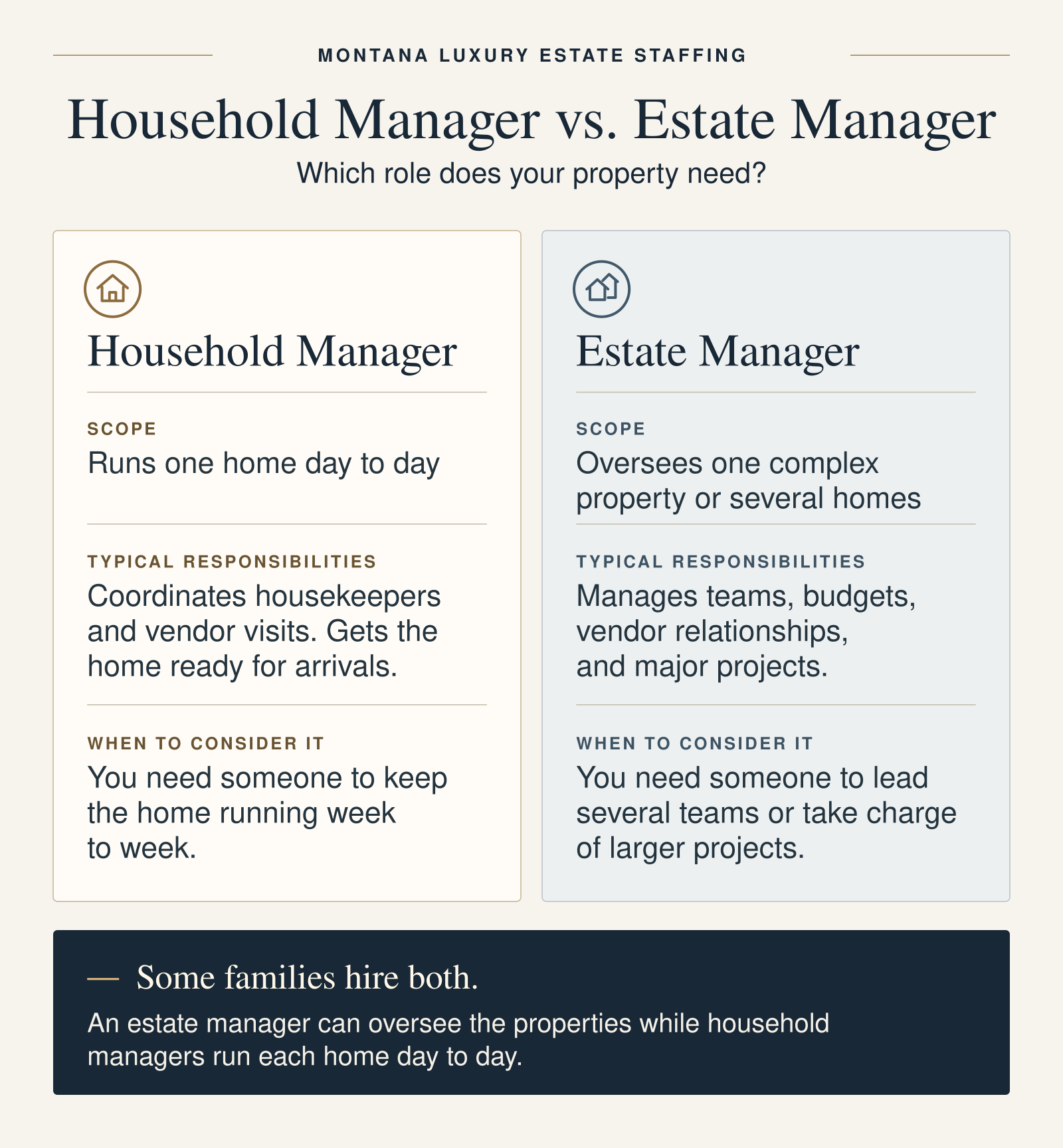
A household manager runs one home day to day, coordinating housekeeping, vendor visits, and arrivals. An estate manager oversees one complex property or several homes and manages teams, budgets, vendors, and major projects. Some families hire both: household managers run individual homes while an estate manager oversees the properties as a whole.
How do you decide which role to hire for?
Before you write the job description, take a few minutes to think through an ordinary week and any bigger projects on the horizon.
What do I want this person to take off my plate in a normal week?
Which homes, teams, vendors, and projects would they be responsible for?
What can they handle or approve on their own, and what decisions should come to me?
Who’s already doing this work, and where are the gaps?
Can a family have both?
Yes. A family with several homes might have one estate manager overseeing the properties and a household manager handling daily operations at each home. In that setup, the household managers often report to the estate manager, who reports to the principal, meaning the family member or owner they work for. A household manager may also speak directly with the principal about what’s happening at their home. The exact reporting structure depends on how the family and staff work together.
If you already have good people in place, start by looking at what they cover. You may need someone to coordinate the teams across properties, or you may simply need more day-to-day support at one home.
What happens when the job gets too big for one person?
This is something we see in private staffing. A family hires a household manager to run the home, then asks the same person to oversee a major renovation. The housekeepers still need support. Vendors still need access. The family is coming on Friday. And now the contractor needs a decision that could affect the project budget and timeline.
When both jobs need attention at once, even a capable manager can burn out. The housekeepers may lose the day-to-day support they counted on, and small issues can start coming back to the family.
A household manager can grow into broader responsibilities over time if there’s a plan for who will cover the work they’re handing off. If you need someone to lead several teams, manage significant budgets, or oversee a major project from day one, build those expectations into the role and compensation from the start.
How do you know a candidate has the right experience?
In our interviews, we sometimes meet candidates whose title was estate manager but whose work centered on running one household. They may have done that job very well. If your hire will be responsible for several teams, a substantial budget, or a major renovation, you’ll want to know whether they’ve handled that level of responsibility before.
At Montana Luxury Estate Staffing, we interview and screen candidates before you meet them. We ask what they were personally responsible for. Who reported to them? Which spending decisions could they make? Did they lead the renovation or help coordinate contractor visits? That gives us a clearer picture of what they can take on and saves you from spending interview time on candidates whose experience falls short of what the role requires.
When a hire is out of their depth, you can end up making the decisions you hoped to hand over while the rest of the team picks up extra work. If the person leaves, you’re paying to recruit and train again. Screening for the actual responsibilities upfront helps protect your time, your budget, and the team you already have.
If you’re still deciding which role to hire for, come back to what you want someone to take off your plate, what your team already handles, and which decisions you’re ready to hand over. You can talk it through directly with Sarah, our founder. She’ll help you define the role and work out what experience your hire needs from day one.